
Starting this May, mortgage folk are going to be required to send Freddie and Fannie data including additional data points in ULDD phase 3 extension. At face value, adding these additional data points shouldn’t be a big deal at all. However, the legacy code I’m maintaining used XML::Compile to generate code. For various and sondry reasons — which I will not go into here — XML::Compile in the code I’m maintaining was in a place where it was extremely difficult to add XML elements that weren’t included in the original base Mismo 3.0 namespace.
Read more...“Let the words of my mouth and the meditation of our hearts be acceptable in your sight O Lord, our rock and our redeemer.”
The season of Epiphany has been all about God revealing himself to his people. In Advent we await the coming King. At Christmastide we stand awestruck as God enters our filth. In Epiphany we see the perfect revelation of God in Jesus Christ. Epiphany drives us to contemplate what it means for Divinity to fully intersect with fallen humanity. Jesus stands wrapped in common cloth with dirt-caked feet on a hill and yet reveals himself to glow brighter than the sun and converse with the prophets. Jesus crosses the surface of the waters like they are streets of glass only to enter a smelly fishing boat full of peasants.
Read more...Recently, I needed to get cron working inside a Docker container running Debian Slim. It’s not difficult once you figure it out, but it did take a bit of research and learning to get everything to work.
First off, Debian Slim is real slim. There’s no cron nor is there a syslog when you want to debug things. Add apt-get install cron and rsyslog in your Dockerfile before you start anything else. With syslog installed, you can tail /var/log/syslog while you’re debugging your cron files, which is incredibly helpful.
Each Sunday at Church of the Epiphany we record our sermon using someone’s mobile phone. We started doing this back in September and, for the last three months, editing and uploading these sermons to our website has been a fairly manual process. Starting this month, however, with a combination of JustCast, Dropbox, Hazel, Squarespace, and Auphonic I’ve been able to mosty automate the process.
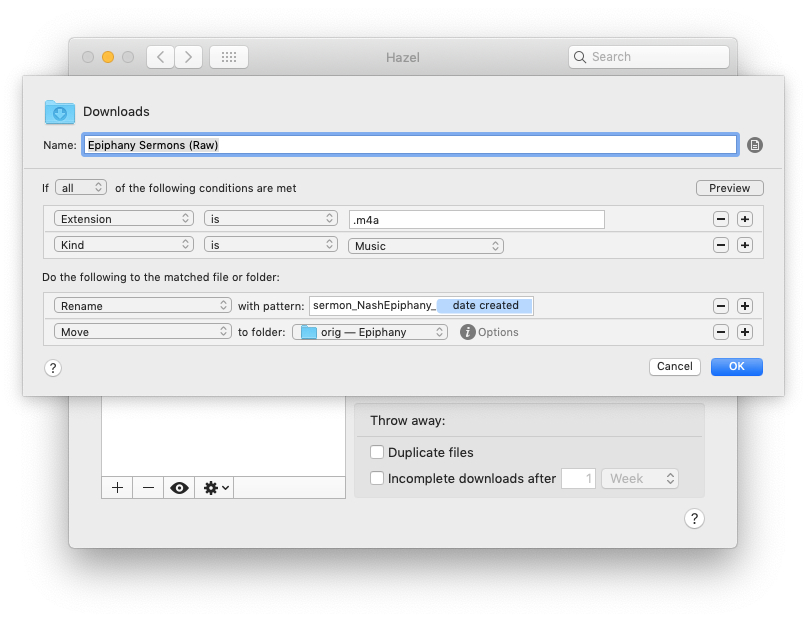
Each week shortly after worship, Fr. Justin e-mails me the audio recording of his sermon from his phone. His Android phone defaults to .m4a for audio, so I’ve setup a simple Hazel rule to monitor my download folder for that extension so the file is quickly renamed and moved off to my external archive drive.
Knowing and owning one’s theological lens is a good thing in pastoral ministry. Theological lenses, however, become problematic in chaplaincy and other ecumenical contexts. In my time as a chaplain at a nursing home and now in a jail, I have personally struggled with how to minister to those with differing theologies from mine while maintaining and affirming my own Anglican commitments. How can I “conform to the Doctrine, Discipline and Worship of Christ as this Church has received them” as the ordinal directs while also ministering within a non-Anglican context?1 How can I maintain the received theologies of the Catholic faith on ecclesiology, sacraments, and ordained ministry — which I wholeheartedly believe to be true and right — while also affirming the work of the Holy Spirit all around me?
Read more...Many of the essays on this site start their life in Microsoft Word or Scrivener. Early on, I would have to convert essays to Markdown for posting manually. This generally worked okay, but I lost my footnotes. I tried Word to Markdown for a brief while, but it didn’t work entirely as I’d like it to. Enter Pandoc. I’ve been using Pandoc to convert all of my Word documents — including footnotes — for the last two years. I’ve been delighted with the results.
Read more...



 ]
] ]
] ]
] ]
]