
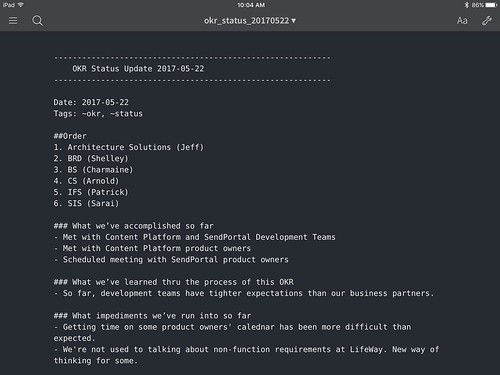
Switching to plain-text notes using the Sublime Note package was a huge boon to my daily productivity. Not only was Sublime Text more stable than the previous alternatives, it used less memory, was easier to search thanks to Alfred/Spotlight, and — when paired with Dropbox — synched quickly across all of my devices.
My only problem was my inability to easily edit notes on my iPad. Yes, I could take my MacBook Air with me from meeting to meeting, but thanks to my Microsoft Universal Keyboard I was now too spoiled by my small and light iPad mini + keyboard setup. I needed an iOS plain text editor that synched with Dropbox.
Read more...Several months ago I followed the lead of my friend Jon Boulineau and switched from Evernote/Simplenote/OneNote for my note taking needs, to Sublime Text using the Sublime Note package.
Sublime Text uses significantly less system resources than the alternatives and is incredibly stable at all times. Further, when synched via Dropbox, all of my super-small, plain-text note files are instantly available on all of my devices — mobile and otherwise.
The Sublime Notes package gives one syntax highlighting and about everything one might need, except for a default note template. Creating this in Sublime Text 3 is a very easy operation.
Read more...To be a Christian often means living in the undefined spaces of tension between things that together cannot be true and yet are. Take today for an example. In the Christian calendar, today is the seventh Sunday of Easter and the first Sunday after Ascension. Also today, many Christians in the United States will reflect upon the lives lost over the centuries by the United States Armed Forces as a church prelude to Memorial Day on tomorrow.
Read more...I’ve been an Alfred user for many years, but until I moved to LifeWay, I’d never had the opportunity to use a Macintosh — and thus Alfred — as part of my daily work. For me, Alfred was always about quick launching applications, doing quick calculations, and checking the spelling and definition of words. Thanks to my daily use at LifeWay and the guidance of the Mac Power Users, I’ve upped my Alfred game significantly over the last several months. Today, I’m going to share one of the many Alfred workflows I’ve come to rely on.
Read more...Humanity and the Church or, to cast them in more theological terms, theological anthropology and ecclesiology, are highly related doctrines that often get overlooked in the Christian theological community. First providing a brief history to setup a framework for theological discourse, I seek to better understand what humanity is in the eyes of and relationship to God and to define what the Church is and is called to be in the world. With a clear framework in place and the doctrines sufficiently defined, I will place Christian anthropology into conversation with ecclesiology and tease out the common theological thread in both sources that lead to a theology of Divine relationship as the true telos of the human creature and the Church.
Read more...As the only source of life and being, God is in a constant state of giving to his creation. Because he wills it, humanity, the earth, and the cosmos are. In this very abstract sense, all things “visible and invisible” are a revelation of the God who creates and sustains them. The enterally triune God, however, is not chiefly a god of the abstract. He is a god of the particular.
Read more...



 ]
] ]
] ]
] ]
]