
It’s been three and a half years since I closed Sublime Text and entered the world of Outlook and PowerPoint. In a lot of ways management has been what I thought it would be. There are poltics. There are constant temptations to compromise for my benefit over the developers on my teams. There are boring budgeting and strategy meetings. There are e-mails. So. Many. E-mails.
Overall, however, management has, for me, been exactly what I set out for it to be at the beginning. I willfully entered management to be the manager I always wanted — and often needed — when I was a developer. I work hard to cut back bureaucracy, politics, and process from my teams. I look for ways to empower developers to self-lead and self-manage their craft. I strive to be there for developers when needed and be completely invisibile to them when I’m not.
Read more...A while back I got the idea in my head that I needed a fileshare for my classic Macintoshes. The move to HTTPS in recent years has left ancient browsers out in the cold for hitting classic software repositories like Macintosh Garden which meant I needed to either suffer the pain of heavy browsing in Classilla on my iMac G4 or download files on a modern machine that the Macs could get access to. Initially I thought a simple FTP server would suffice. Though FTP got the job done more or less, FTP clients such as Fetch would freeze on >100MB downloads on my older machines like the Quadra 630. FTP just wouldn’t cut it. I needed a proper AppleTalk fileshare.
Read more...Since August I have been volunteering as the chaplain intern at a retirement community and nursing home in the Middle Tennessee area. Over the months, I’ve spoken and prayed with many people as they’ve reflected on and — sometimes — mourned their journey through time. Over and over again — often through tears — I’ve witnessed people who regretted allowing the Alltag1 of life stand in the way of their experiencing God’s creation in its fullness.
Read more...At the center of what makes Christian theology distinct from the general theological conversations of the religious traditions of the world, is the Christian engagement of Jesus. Other traditions – Judaism and Islam particularly – have something to say about the historical person of Jesus of Nazareth; his life, ministry, and teachings. Only Christianity, however, places cosmic implications on Jesus. Within the Christian tradition, Jesus is not only prophet, rabbi, and rebel, but also Messiah, Christ, or “Anointed One.” Christology, then, within the Christian theological tradition, is to define precisely who the historical Jesus of Nazareth was and what the cosmic implications of his life are for humanity and all of creation.1
Read more...So much of theological education involves interaction and time with the darker sides of the faith. The troublesome passages of the Bible are given greater focus so we can integrate them into a coherent system with the nicer ones. We learn to deal with death, with rejection, with suffering. We study and focus on all the things the church and world would like to forget exists, so we can be prepared to face them when we enter ministry.
Read more...

Development teams are a lot like a church congregation.
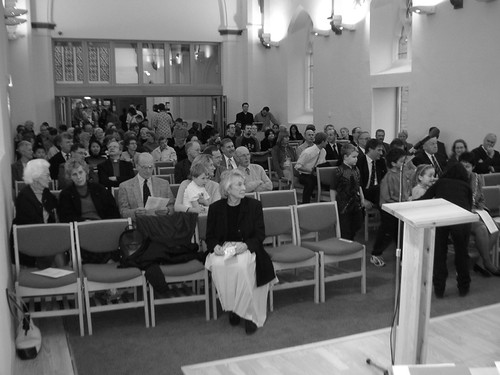
A congregation is a community of people with special skills and jobs. You have pastors, preachers, choir directors, ushers, worship leaders, organists, etc.

It takes everyone working together doing their special jobs to make a worship service happen.

Development teams are also a community of people with special skills and jobs. You’ve got developers that specialize on certain parts of the stack, people who do different types of testing, people who have specialties in breaking down and managing the work of developing software, etc., etc., etc.
Read more...



 ]
] ]
] ]
] ]
]